New PlayMatters research published in peer-reviewed journal highlights the promise of learning through play in crisis settings
May 21, 2026
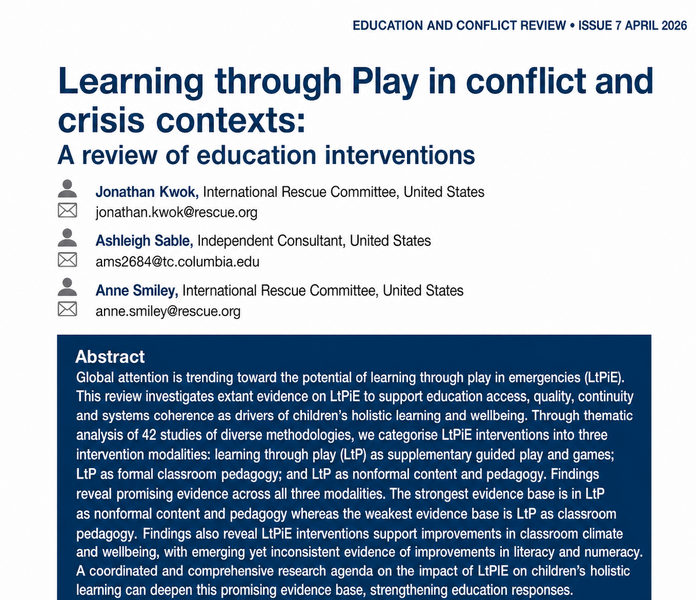
A new PlayMatters research study, Learning through Play in conflict and crisis contexts: A review of education interventions, has been published in the Education and Conflict Review (ECR), an open-access, peer-reviewed journal published by the Centre for Education and International Development (CEID) at the UCL Institute of Education, University College London. The journal brings together research and practice at the intersection of education, conflict, and international development, with a strong focus on what works for children and education systems in crisis-affected settings.
The publication marks an important milestone for PlayMatters and contributes to the growing global conversation on how learning through play can support children’s learning and wellbeing in some of the world’s most challenging contexts.
What the research looked at
The review explores the emerging evidence on learning through play in emergencies and how it can support key education goals in conflict and crisis settings, including access, quality, continuity of learning, and stronger systems coherence.
Drawing on a thematic analysis of 42 studies using a range of research methods, the paper identifies three main ways learning through play is being used in crisis contexts: as supplementary guided play and games, as formal classroom pedagogy and as non formal content and pedagogy. Together, these three modalities offer a useful framework for understanding how play-based approaches are being applied across different education responses and delivery models.
What the findings show
The review finds promising evidence across all three approaches. It found that learning through play interventions in crisis contexts are contributing to improved classroom climate, stronger child wellbeing and more engaging and supportive learning environments.
The evidence for improvements in literacy and numeracy is described as emerging but still mixed, pointing to a growing body of encouraging findings, while also underscoring the need for more rigorous and coordinated research. However, this study builds on growing evidence from the PlayMatters Randomized Control Trial in Ethiopia and Uganda, which shows learning through play having improved literacy, numeracy and socio-emotional learning outcomes for children, as well as improved teacher wellbeing.
Why this matters
For children affected by conflict, displacement, and crisis, education is about far more than academic content alone. It is also about safety, continuity, belonging, emotional wellbeing, and the chance to keep learning in the face of disruption. This publication reinforces an important message: learning through play has strong potential to improve not only how children feel in learning spaces, but also how they participate, engage, and thrive.
At a time when the global education sector is increasingly seeking cost-effective, scalable, and context-responsive approaches in crisis settings, this review helps strengthen the case for integrating play more intentionally into education responses.
What this means for PlayMatters at scale
For PlayMatters, the publication is both a recognition of the project’s contribution to the evidence base and a reminder of the work still ahead. As PlayMatters enters its next phase, with a stronger focus on scale, institutionalization, and national ownership, the findings help affirm the relevance of learning through play as a practical and promising approach in refugee and host community settings. At the same time, the paper highlights the need for continued investment in research on how learning through play can be embedded more deeply in formal classroom teaching, where stronger evidence is still needed.
This aligns closely with PlayMatters’ broader commitment to pairing implementation with evidence, while contributing to global learning on what works for children in conflict and crisis contexts.
Read the full article
You can read the full open-access article, Learning through Play in conflict and crisis contexts: A review of education interventions, in the Education and Conflict Review (ECR).