Low-cost tools, high impact: Sustaining learning through play through co-creation and improvisation of teaching and learning materials
Meaningful learning does not always require expensive resources.
Feb 13, 2026
Learn more about how teaching and learning materials are being used at Katiku Primary School in Madi-Okollo District, Uganda, where teachers and learners share how simple, creative resources are making lessons more lively, meaningful, and engaging.
Everyday materials as teaching and learning tools
Meaningful learning does not always require expensive resources. Across schools supported by the PlayMatters project in in Uganda, Ethiopia, and Tanzania, teachers are demonstrating that creativity and collaboration can transform simple, everyday objects into effective teaching and learning tools.
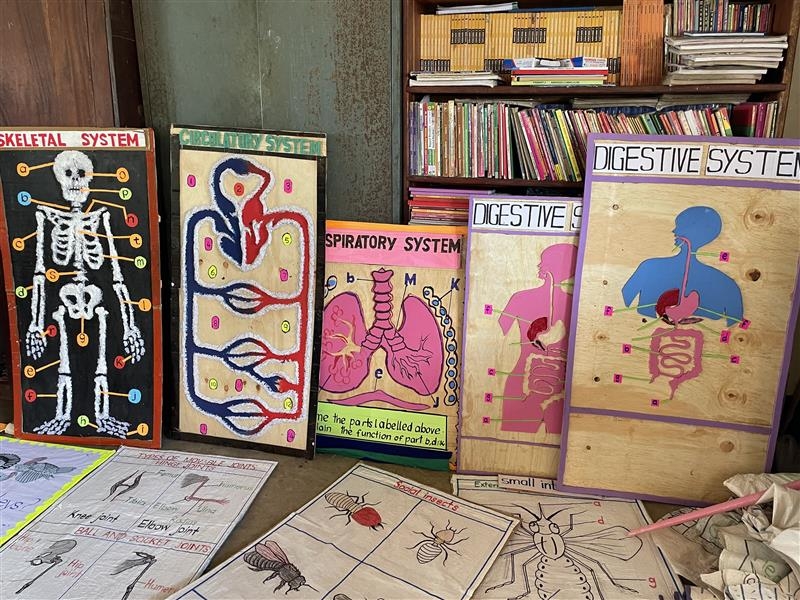
A core element of Learning through Play is promoting intentional interactions with people and materials that allow children to question, experiment, practice, and discover. In many classrooms, this principle is coming to life in practical ways. Bottle tops become counters for numeracy games. Hand-drawn charts support early reading and language development. Clay, cardboard, and recycled items are shaped into maps, models, and learning aids.
These improvised materials help make abstract concepts more concrete, using what is readily available, locally relevant, and cost effective.What makes these tools so impactful is not what they are made of, but how they are used. When these materials are used in everyday teaching, lessons become more engaging and meaningful. Classrooms become more interactive spaces and learning connects more naturally to local culture and everyday life.
Handcrafted teaching aids illustrating the human body systems displayed in a classroom setting, supporting interactive and visual learning
This approach is being strengthened through structured collaboration. Teachers exchange ideas through teacher learning circles and coaching sessions, sharing practical ways to improvise materials for different subjects and age groups. A chart made from old cartons becomes a science diagram. Stones and sticks become math manipulatives.
What worked in Tanzania
Experiences from Tanzania show how this practice can be sustained at scale. PlayMatters worked alongside with teachers and school leaders to strengthen skills in creating and using locally made teaching and learning materials. Training was complemented by ongoing coaching and mentoring from ward-level improvisation task forces made up of senior teachers. These mentors supported schools to continuously produce and use materials drawn from local environments.
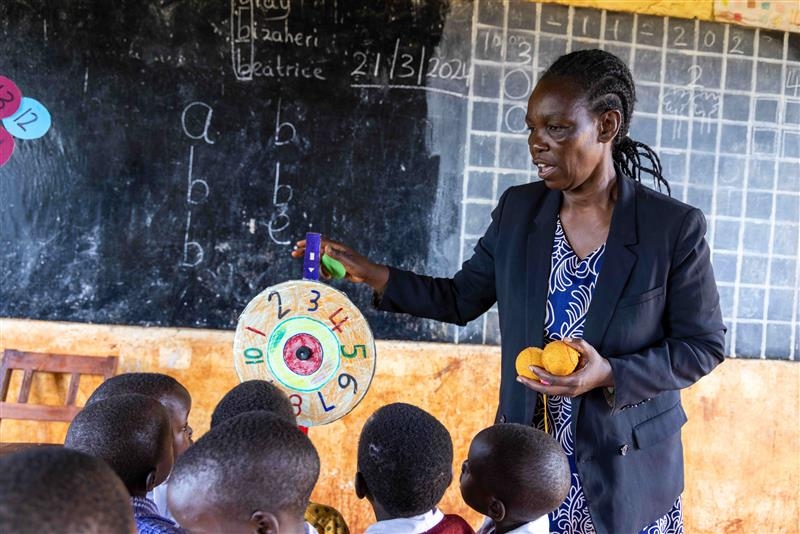
Teacher Beatrice in a Primary two class in Kibondo Tanzania
The results have been encouraging. Classrooms have become more inclusive and engaging, with learners showing greater participation and confidence. Teachers report feeling more creative in lesson planning and more equipped to adapt lessons to the needs of their learners. Because materials are made from locally available items, schools can continue using and adapting them over time without relying on external supplies.
This model is also highly practical. It supports teachers to work effectively even in large classes and low-resource environments. Most importantly, it shows that Learning through Play does not depend on costly inputs, but on practical skills, collaboration, and a commitment to child-centered learning.