A day in the life of a PlayMatters teacher
A case of Teacher Opio
Nov 25, 2025
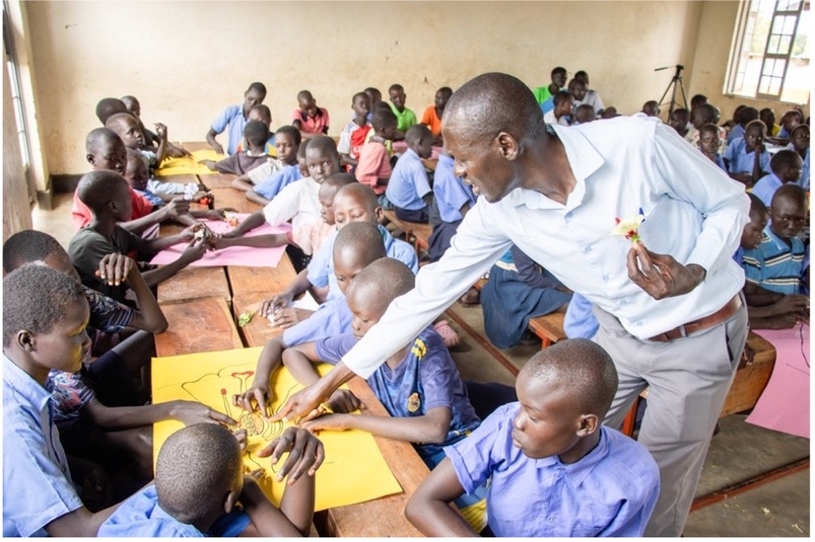
At the break of every dawn in Palabek refugee settlement, Lamwo District, Bright Future Primary School opens to the sound of children’s laughter echoing across the village. In the middle of this energy is Teacher Thomas Opio, a dedicated educator with more than seven years of teaching experience, whose classroom has become a space of joy, creativity, and discovery. He teaches literacy to primary three and science to primary four.
Bright Future Primary School, founded in 2022 to provide not only education but hope to refugee children, has quickly grown into more than just a school; it is a sanctuary where learners heal, learn, grow, and dream. For Teacher Thomas, it is also the ground where he brings to life the Learning Through Play (LtP) approach, a methodology he first encountered in 2023 during a foundational training organized by International Rescue Committee, the lead implementing partner of the PlayMatters Project in partnership with Plan International, War Child Holland, Innovations for Poverty Action (IPA), and the Behavioural Insights Team (BIT).
Since then, each day in his classroom tells a new story, where lessons are no longer about rote memorisation, but about games, songs, role plays, and interactive activities that spark curiosity and nurture confidence. His pupils don’t just learn; they participate, question, and play. From the morning roll call to the last school bell in the evening, his day is a testimony that education can be both fun and impactful, especially in communities where hope is needed most. His commitment recently earned him recognition as one of the best teachers in Lamwo District, a true reflection of how play can change not just classrooms, but entire communities.
“Every day at Bright Future Primary School begins with the excitement of seeing my learners eager to play and learn. With the Learning Through Play approach, I no longer stand in front of a silent class; I move among curious children, guiding them through songs, games, and activities that make even the hardest lessons enjoyable,” Tr. Thomas Opio
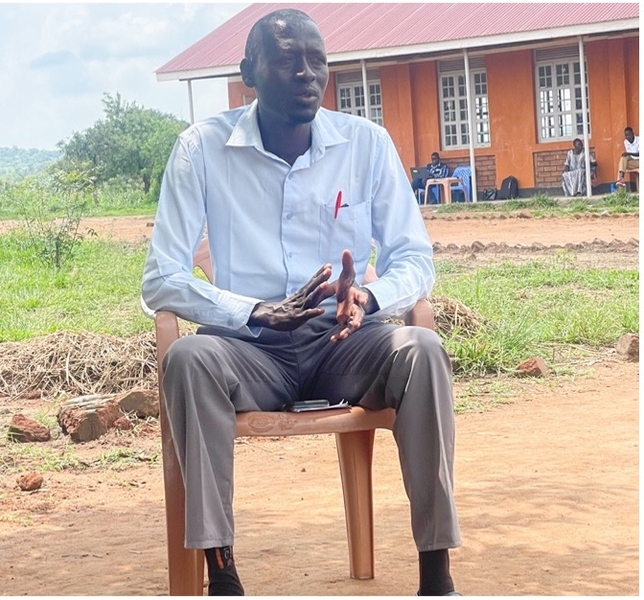
Arrival and Preparation for the Day
Teacher Thomas arrives at Bright Future Primary School early, ready to set the stage for a day of meaningful learning. His first stop is the staffroom, where he signs in and reviews his detailed lesson plans prepared the day before, alongside the scheme of work for the day. For him, early preparation has become a cornerstone of effective teaching.
“With the knowledge and skills I gained from the Learning Through Play Foundational training and the continuous mentorship received from our head teacher, I have learned the importance of preparing adequately before stepping into class, “I now collect and organize teaching and learning materials ahead of time, whether it’s plants, soil samples, flowers, stones, or charts and manila papers. This preparation is not just about order; it’s a skill I developed through the Learning through Play methodology, which has taught me how to make lessons more interactive and meaningful.” Thomas explains.
At the time of documenting his routine, Thomas was preparing for his first lesson of the day, Science in Primary Four, the class he teaches. True to his word, his classroom was already set up with locally sourced Teaching and Learning Materials, carefully arranged to support the day’s science topic. These real-life items not only brought context and relevance to the lesson but also ensured that learners would not just listen but participate fully. This preparation has become the backbone of his teaching, making each lesson interactive, engaging, and learner-centred. As part of his morning routine, he leads the morning assembly with his colleagues. They guide the learners through songs, recitations, and announcements, setting a focused tone for the day. After the assembly, learners go to their classrooms, and he cheerfully starts the first lessons of the day.
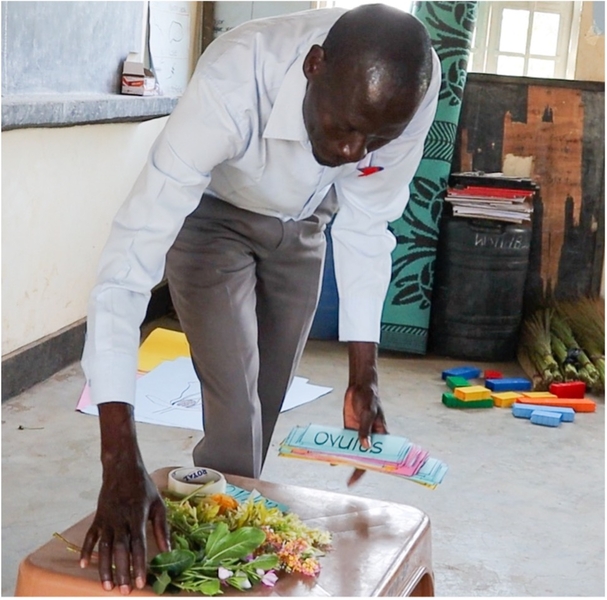
Thomas is organising the teaching and learning materials in class before the lesson begins.
Lesson Delivery in Action
Once the morning assembly concludes, Thomas begins his first lesson of the day in Primary Four. He teaches Science and the topic today is aboutflowers. Entering the classroom, he greets the learners warmly, and before diving into new content, he conducts a class roll call to track attendance for the day, briefly recaps the previous day’s lesson, asking targeted questions to reinforce prior learning and ensure continuity. Learners respond eagerly, showing that they recall key concepts and are ready to build on them.
Thomas introduces the new topic by connecting it to the learners’ everyday experiences. “Have you noticed the flowers in our school garden?” he asks. “Today, we will explore their parts and understand how they help the plant grow.” He uses the prepared manila cards, fresh flowers, charts, and even LEGO bricks to make the lesson concrete and engaging. Learners are encouraged to touch, observe, and discuss.
Throughout the lesson, Thomas actively engages learners using the LtP strategies such as group work for peer collaboration, observation, think and talk and Listen, Say, and Use. Some learners work in small groups to assemble flower models, while others use charts to label parts correctly, promoting peer learning and active participation. The classroom buzzes with curiosity, joy and hands-on exploration.
As the lesson draws to a close, Thomas consolidates the learning by summarizing key points and checking for understanding. He then assigns exercises for learners to complete individually, applying what they have learned. While learners work, Thomas moves around the classroom, observing, providing guidance, and marking their work in real time. His feedback is immediate and constructive, reinforcing learning and encouraging further inquiry. The learners leave the classroom engaged, confident, and curious, carrying with them not just knowledge but the joy of exploring and learning through play.
Break Time: Building Social and Emotional Well-being
Around mid-morning, Thomas gives the learners time to take a well-deserved break to relax and recharge. This time is more than just a pause in the day; it plays a crucial role in promoting psychosocial well-being. During the break time, learners engage in co-curricular games, socialize, and play games. “Break time is important because it gives learners a chance to refresh their minds and develop socially and emotionally. When they return to class, they are more focused and ready to learn again,” explains Thomas. After the break, Thomas transitions between classes. His routine class delivery continues.
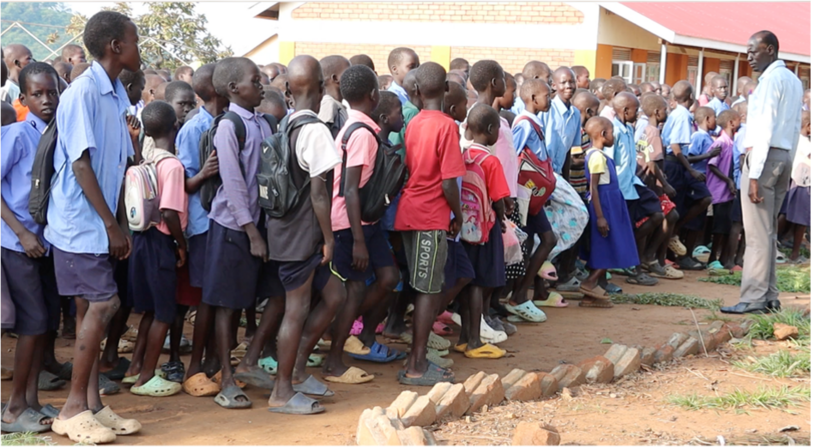
Teacher Thomas Opio leads the morning assembly at Bright Future Primary School, energizing and motivating learners to start the day with focus and joy.
Lunch Break
During lunchtime, learners eat and unwind, while Thomas uses part of this period to prepare for afternoon lessons. He also meets briefly with other teachers to discuss challenges and share strategies for to deliver his lessons more effectively.
Afternoon – Continued Lessons and Homework Assignment
The afternoon session focuses on continuing lessons across different streams. Thomas integrates subject content with LtP activities that encourage creativity and critical thinking. As the lessons wind down, he assigns homework that reflects the day’s key concepts. This reinforces learning at home while encouraging learners to share new ideas with their families. Peer-to-peer teaching naturally occurs during these sessions, as learners explain concepts to one another.
Evening Reflection and Mentorship
As the school day winds down, the teachers at Bright Future Primary School gather in the school compound for a reflective session, a practice introduced shortly after the LtP intervention. This period allows them to review the day’s lessons, share successes and challenges, and learn from one another’s experiences. The headteacher plays a key role in this session, guiding discussions and offering mentorship to ensure that the principles of LtP are consistently applied in the classroom. With thoughtful feedback and practical advice, the headteacher helps teachers reflect on what worked well and identify areas for improvement. Thomas and his colleagues discuss how learners engaged with hands-on activities, the effectiveness of group work, and ways to further incorporate playful, learner-centred strategies into future lessons. For Thomas, this reflection period is invaluable. “It’s a moment to pause and think about what we achieved today, and how we can do even better tomorrow,” he explains. “The headteacher’s guidance helps us stay focused on making learning meaningful and enjoyable for the pupils.”
By the end of the session, teachers leave not only with insights into their own practice but also renewed motivation and practical ideas to continue fostering curiosity, creativity, and active participation in their classrooms. This evening reflection has become an integral part of the school culture, strengthening teaching practices and sustaining the impact of Learning through Play at Bright Future Primary School.
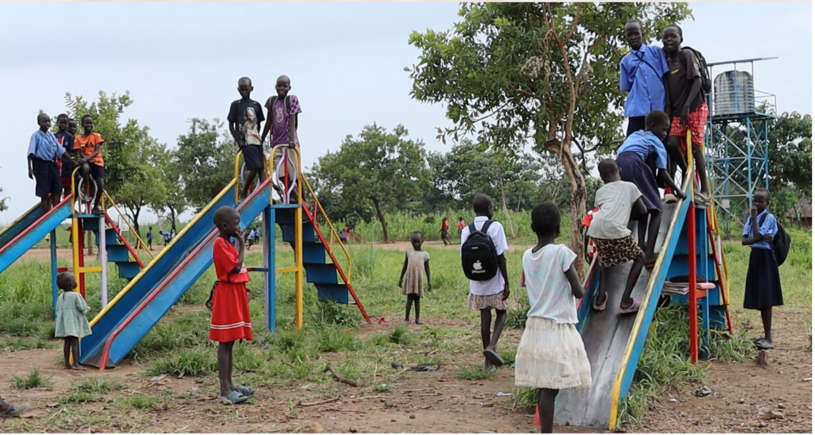
Learners enjoy a playful moment on the swings during break time, building friendships, teamwork, and emotional well-being while recharging for the next lessons.
Day’s achievements and challenges
Thomas’s routine journey as a teacher reflects the transformative power of Learning Through Play, proving that when education is engaging and inclusive, every learner can thrive. He reflects that the approach is both rewarding and challenging. Thomas mentions, “One of the highlights was seeing my learners so engaged during our lessons. They observed, discussed, and demonstrated using the provided teaching and learning materials. It was incredible to witness their curiosity and excitement firsthand.” However, Thomas acknowledges some challenges associated with the approach. “Time management is always tricky; there’s so much to do within a limited lesson period. Sometimes, resources are not enough for every group, and some learners need extra guidance to fully grasp the concepts”.
Closing thought
Thomas admits how different his teaching was before he encountered PlayMatters. “Before the training, my teaching was mostly about using the chalk and the textbook,” he recalls. “I would walk into class, write notes on the blackboard, and expect learners to copy and memorise. There was little room for interaction, and at times my learners struggled to connect what I was teaching.”
The shift has been transformative. “With the skills I gained from the LtP methodology, I now prepare my lessons differently. I collect teaching and learning materials beforehand, plants, and organize them in class before the lessons begin. This preparation helps me bring the lesson to life, making it interactive, engaging, and centered on the learner. By the time we start the day’s lesson, my pupils are excited and ready to participate fully."
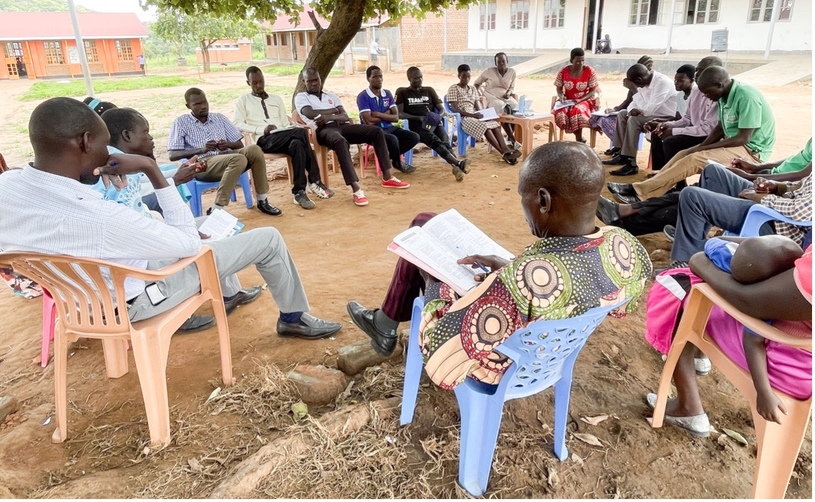
Teacher Thomas is engaging with colleagues during the end-of-day reflection moment to share the day’s experiences as the headteacher guides them through.
Thomas now feels a strong sense of purpose. “Each day, I see how much Learning through Play has transformed my career and my classroom experience. It has motivated me to keep improving. I’m learning not just how to teach better, but how to inspire my learners to enjoy learning and think creatively.”